
Published in collaboration with Denny Chared, Founder of DC Finance & The Family Office Circle
Summary: Family offices do not evaluate opportunities like institutions. They invest their own capital, prize discretion, and think in generations. Approaches that work with VCs or PE often miss the mark here. This four-part field guide, developed with Denny Chared, whose global community spans 18+ cities, covers the practical shifts that win attention, build trust, and convert interest into long-term partnerships.
Why family offices (still) matter
Institutional markets are cyclical; family capital is continuous. Families can move faster, structure creatively, and support beyond the check—introductions, customers, and credibility that compounds. But that access is gated by fit and trust, not just IRR. If you treat a family office like a mini-VC, you’ll likely get mini-results.
At Family Office Access (FOA), we collaborate with DC Finance throughout the year and regularly extend preferred member pricing for their conferences, salons, and private dinners. We see, firsthand, what separates the conversations that go nowhere from the ones that lead to durable, values-aligned partnerships.
Part 1 — The first minute: earn the right to go deeper
Most teams lose the room in the opening 60 seconds. Here’s how not to…..
Make the positioning unmistakable
One sentence should answer what you do, for whom, and why it matters now. “We make urban logistics carbon-neutral for under $0.50 per parcel.”
Follow immediately with three proof points; traction, margin profile, and moat. You’re anchoring credibility without drowning the audience in detail.
Put the right voice on stage
Your best evangelist may not be the inventor. Families buy clarity and confidence, not titles. If the technical founder is brilliant but dense, let a strong communicator lead, then invite the founder into Q&A.
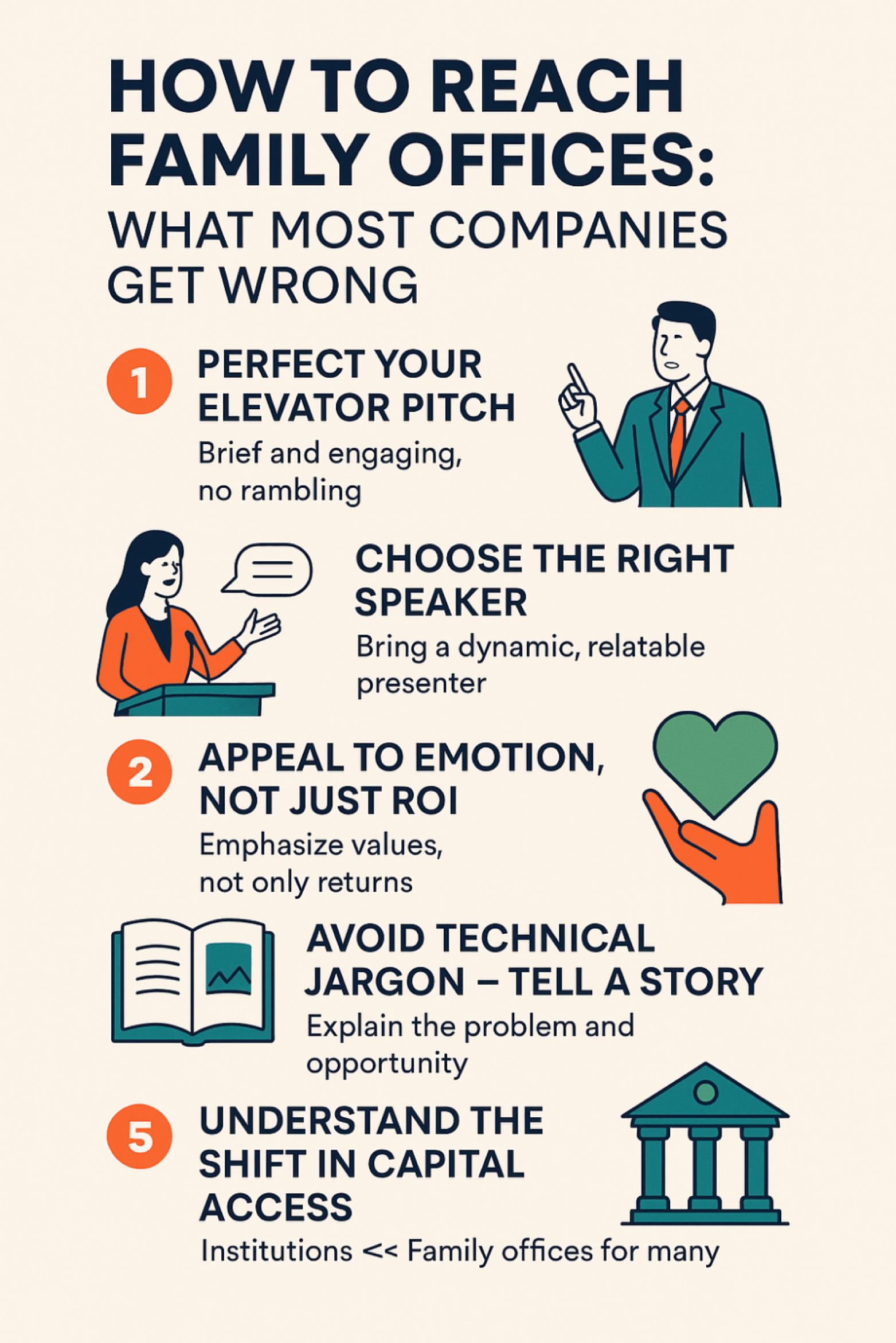
Lead with meaning (then back it with numbers)
Institutional investors are obligated to optimize for return; families also optimize for fit: legacy, values, lived experience. Say the quiet part out loud: why this matters to people and place. Then show the unit economics.
A pharma investor first backed a company because a therapy helped his spouse. When he later learned the company employed people with disabilities, he became a board advocate and brought friends into the round. Emotion created the bridge; performance sustained it.
Tell a story, not a spec sheet
Most families are sector-agnostic generalists. If your first three minutes require a PhD to follow, you’ve lost them. Walk through the user, the problem, and the “why now” (in plain language).
Practice radical transparency
Markets wobble. Families respect founders who report clearly through good and bad. Quarterly letters that explain what happened, why, and what’s next earn patience; spin destroys it.
Part 2: Relationship building & investor readiness
Winning family capital is like dating: confidence helps; neediness hurts.
Be “data-room ready” before first contact
Preparation accelerates trust. Have these in place:
- Clean cap table + SAFEs summary (signals alignment and future dilution tolerance)
- Cohort-level unit economics (depth beyond vanity revenue)
- 12-month cash forecast (answers “how far does our capital take you?”)
- Customer references on standby (cuts diligence time in half)
If a random question (burn bridge, GTM specifics, co-founder dynamics) knocks you off balance, confidence evaporates. Don’t go on the date if you’re a mess.
Follow up with tempo, not pressure
- Reply cycles: 1–2 weeks is normal; principals travel and gatekeepers screen.
- After intro calls: wait 7–10 days, then share a crisp update or single question.
- The long game: many families track for 6–18 months before a first wire. Treat each touchpoint as a chapter in a longer story.
Great companies still need marketing
There’s a myth that quality speaks for itself. In family-office land, signal matters: thoughtful content, selective stages, and warm recommendations. Next-gens, in particular, reward boutique partners who “try harder.”
Part 3 — The 10-point checklist to earn a serious look
- Prove mandate fit in one line.
Tie your mission to stated interests (e.g., “Your ocean-restoration work aligns with our coastal carbon capture tech.”) - Map the sphere of influence.
CIOs, external advisors, portfolio CEOs—understand who can warm-introduce you. Cold rarely lands. - Show data-room readiness before the first meeting.
If you need a week to assemble basics, you weren’t ready. - Offer flexible instruments.
Co-invest SPVs, convertibles, redeemable prefs, tax-sensitive structures (e.g., blocker corps for non-US investors). - Align on time & liquidity.
State the plan and offer optionality (e.g., secondary rights in Year 5). - Protect reputation.
Tight NDA, risk and crisis-comms plan. Families fear headlines more than term-sheet haircuts. - Engage the next generation.
Invite them to product demos and pilots; they often champion tech/impact internally. - Agree on reporting early.
Quarterly financial + impact dashboards, plus an annual site visit or in-person review. - Plan two-way value.
Explain how their network accelerates your revenue—and where you’ll reserve co-invest slots. - Know SFO vs. MFO realities.
Single-family offices decide faster and lean into legacy themes; multi-families mirror mini-funds with committees and slightly more standardized terms.

Part 4 — Why families fund what others miss
Traditional investors pattern-match; families often pattern-break.
- If you don’t fit the VC mold, call a family. Many iconic outcomes started as “category errors” institutions couldn’t place. Families will bring experts to diligence if the story resonates.
- Start before you need capital. Relationships compound. A warm network twelve months from now starts with a respectful intro today.
- Remember who decides. Advisors advise; family members decide. Passion can bend a mandate.
- Expect the unexpected. We’ve seen tech-only families back pharma because the mission hit home—and then unlock pivotal commercial doors.
Bottom line: lead with your story, not just your spreadsheet. Build trust early, respect the cadence, and align to values. Capital follows conviction.
FOA x DC Finance: how we help
We partner with DC Finance throughout the year. FOA members receive preferred pricing on select conferences, salons, and private dinners, all being high-signal rooms where real relationships form. Considering attendance or sponsorship? We’ll help you choose the right room for your mandate and craft an approach that resonates with families. Our team is happy to help make recommendations based on your goals.

About the contributor

Denny Chared is the founder of DC Finance and The Family Office Circle, a global community serving family offices and ultra-high-net-worth families across 18+ locations.
This article was prepared in partnership with the author. Views are his own. Edited for clarity and flow by Family Office Access.